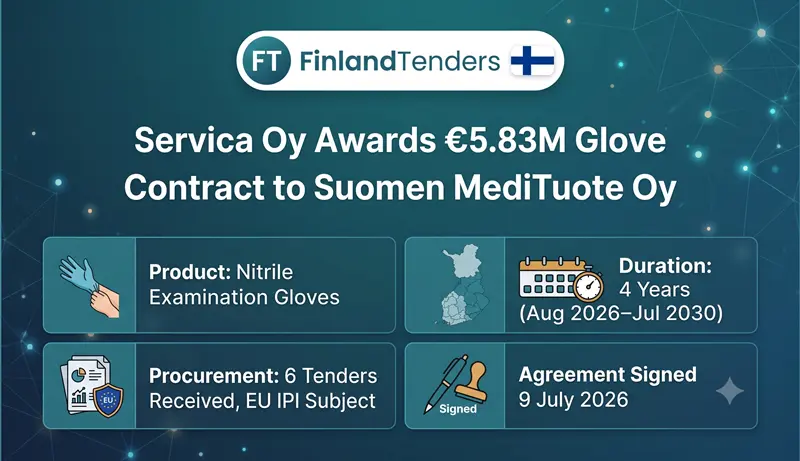
Eastern Finland Health Authorities Lock In €5.8 Million Nitrile Examination Glove Supply Contract Through 2030
15 Jul 2026
Eastern Finland - €5.8M Nitrile Glove Contract Five Finnish wellbeing services counties in Eastern Finland have awarded a four-year contract worth up to €5.83 million for nitrile examination gloves to Suomen MediTuote Oy. The deal, signed on 9 July 2026, covers approximately 5.4 million gloves annually across primary healthcare, long-term care, food services, laboratories and dental care, reflecting the region's commitment to sustainable and socially responsible procurement. Introduction Every healthcare worker depends on reliable personal protective equipment. When that equipment is used millions of times a year across an entire region, the procurement decisions become critical. In Eastern Finland, that responsibility now rests with Suomen MediTuote Oy, after five wellbeing services counties (hyvinvointialueet) signed off on a new nitrile examination glove contract worth up to €5.83 million over four years. It is not a headline-grabbing medical technology deal. But it is the kind of contract that keeps healthcare running smoothly, and it says a great deal about how Finnish public health authorities are approaching volume procurement of essential supplies. Why This Contract Matters Finland's 2023 social and health reform created 21 wellbeing services counties responsible for organising public health, social welfare and emergency services. These counties are significant consumers of medical supplies, but individually they may lack the purchasing power to secure optimal pricing. This contract is a textbook example of regional cooperation in action, aggregating the demand of five Eastern Finnish counties into a single procurement. For suppliers, that means one competitive process can open the door to a large, stable client base across multiple counties. For the counties, it means access to volume pricing and consistent supply they could never secure alone. Contract Timeline Contract award notice published: 15 July 2026 (OJ S 134/2026) Contract concluded: 9 July 2026 Coverage start date: 1 August 2026 Coverage end date: 31 July 2030 Contract Overview Servica Oy, a public procurement company owned by the wellbeing services counties of Eastern Finland, ran an open procedure on behalf of five contracting authorities: Etelä-Savo, Keski-Suomi, Pohjois-Karjala and Pohjois-Savo wellbeing services counties, with Servica acting as group leader. The result is a direct contract (not a framework agreement) covering the supply of nitrile examination gloves for use across primary healthcare, long-term care, food and cleanliness services, laboratories and dental care. The contract is structured as a single lot with a four-year term. Key Contract Details Detail Information Contracting authorities Servica Oy (lead), Etelä-Savon hyvinvointialue, Keski-Suomen hyvinvointialue, Pohjois-Karjalan hyvinvointialue, Pohjois-Savon hyvinvointialue Winning bidder Suomen MediTuote Oy Contract subject Nitrile examination gloves, CPV 33000000 Procedure type Open procedure Legal basis EU Directive 2014/24/EU Estimated value (excl. VAT) €5,000,000 Value of contract awarded €5,834,787 Contract duration 1 August 2026 – 31 July 2030 (4 years) Bids received 6 EU funding None disclosed Covered by GPA No Contract signed 9 July 2026 Project Scope The contract covers a volume nitrile examination glove used across multiple healthcare environments. The glove must be suitable for nursing work, food and cleanliness services, laboratory work and dental care. The supplier's range must include at least sizes XS to XL. Estimated monthly consumption across all five counties is substantial: Size Monthly Volume (units) XS 11,000 S 1,153,700 M 2,825,300 L 1,257,500 XL 179,200 Total 5,426,700 The supplier commits to a maximum delivery time of six months for the first delivery, with the first delivery estimated at one month's consumption. The estimated annual volume across the counties is approximately 65 million gloves. About the Contracting Authorities Servica Oy is a public procurement company owned by the wellbeing services counties of Eastern Finland. It acts as a joint procurement unit, managing tenders on behalf of its owner counties to achieve economies of scale and procurement efficiency. The five wellbeing services counties (hyvinvointialueet) are public bodies responsible for organising health and social services in their regions. They were established as part of Finland's 2023 social and health reform, which transferred responsibility for public health and social welfare from municipalities to these new regional authorities. About the Winning Company Suomen MediTuote Oy is a Finnish medical supply company based in Jyväskylä, classified as a micro, small or medium-sized enterprise. The company supplies a range of medical products to the Finnish healthcare sector. Further details on the company's operations and product range are not disclosed in the notice. Procurement Analysis Procedure: An open procedure was used, meaning any interested supplier could submit a tender. This is the standard route for supply contracts where requirements are well-defined and the buyer does not need extensive negotiation. Competition: Six tenders were received. This is a healthy level of competition for a specialised medical supplies market, indicating strong supplier interest in the contract. Evaluation criteria: Price was the sole award criterion, weighted at 100%. With a single criterion, the award went to the most economically advantageous tender based solely on cost. Framework structure: No framework agreement was used. This is a direct contract with a single supplier for the four-year term. GPA status: The procurement is not covered by the Government Procurement Agreement (GPA), meaning international suppliers from non-EU GPA signatories could not claim access rights under the GPA. IPI measures: The procurement falls within the scope of the International Procurement Instrument (IPI). Specifically, medical devices originating in China are subject to Regulation (EU) 2025/1197. All six tenders received fell under this IPI measure, meaning the bidders were required to comply with the regulation's provisions. No exception to the application of the IPI measure was granted. Strategic Procurement The notice explicitly identifies strategic procurement objectives in two areas: Approach to reducing environmental impacts: The procurement promotes the transition to a circular economy and the protection and restoration of biodiversity and ecosystems. This reflects growing awareness in public procurement of environmental sustainability, even for commodity products like examination gloves. Social objective promoted: The procurement promotes human rights due diligence in global supply chains and fair working conditions. This is particularly relevant for medical gloves, which are often manufactured in global supply chains with varying labour standards. These strategic objectives, combined with the IPI measures targeting Chinese medical devices, suggest the contracting authorities were focused on both sustainability and supply chain resilience. Additional Procurement Facts The contract references no framework agreement, meaning the award is a direct supply contract with Suomen MediTuote Oy. No dynamic purchasing system was used. Disputes or review requests fall to the Markkinaoikeus (Market Court) in Helsinki. The procedure was not accelerated, indicating a standard timeline was followed. Market & Industry Perspective Nitrile examination gloves are a fundamental consumable in healthcare. The COVID-19 pandemic exposed vulnerabilities in global supply chains for personal protective equipment, leading many public health authorities to rethink their procurement strategies. This contract, with its emphasis on circular economy, biodiversity and human rights due diligence, represents a more mature approach to procurement that goes beyond simply securing the lowest price. The IPI measures targeting Chinese medical devices are a relatively new development in EU procurement. Regulation (EU) 2025/1197 allows contracting authorities to restrict or exclude tenders from countries that maintain discriminatory procurement practices. By invoking this measure, the Finnish authorities are signalling a preference for suppliers that can demonstrate compliance with EU standards throughout their supply chains. Economic Significance At €5.83 million over four years, this contract represents a significant portion of the medical supplies budget for five wellbeing services counties. The estimated value of €5 million was exceeded by the actual contract value of €5.83 million, suggesting either higher-than-expected demand or a more competitive pricing structure than anticipated. For Suomen MediTuote Oy, the contract offers a stable, predictable revenue stream through to 2030 and a strong reference in the Finnish public healthcare sector. For the counties, the contract provides supply security and price stability for a critical consumable. Future Procurement Opportunities The four-year term means this contract will not be re-tendered until 2030. However, the notice does not indicate whether the contract includes options for renewal. Suppliers not successful in this procurement may look for opportunities in other Finnish wellbeing services counties, which run their own tenders on staggered cycles. The strategic procurement objectives identified in this notice—circular economy, biodiversity protection and human rights due diligence—may also signal future procurement trends in other regions and other product categories. Opportunities for Suppliers For medical supply companies, the key takeaway is that Finnish health authorities are increasingly integrating strategic objectives into their procurement. Price remains the dominant criterion, but suppliers that can demonstrate compliance with environmental and social standards, particularly in global supply chains, may have a competitive advantage. The IPI measures targeting Chinese medical devices also suggest that suppliers with manufacturing or sourcing outside China, or with robust due diligence processes, may be better positioned for future tenders. What Businesses Should Watch Whether other Finnish wellbeing services counties adopt similar strategic procurement objectives in upcoming tenders for medical supplies. How the IPI measures are applied in practice, particularly the documentation and compliance requirements for suppliers. The uptake of circular economy principles in medical supplies procurement, including product take-back or recycling schemes. FinlandTenders Procurement Intelligence This contract is a useful case study in how Finnish public health authorities are adapting procurement to meet strategic objectives while maintaining cost discipline. The sole price criterion, combined with environmental and social objectives, suggests that the contracting authorities see price and sustainability as compatible rather than competing priorities. The IPI measures targeting Chinese medical devices are significant. This is one of the first high-volume medical supplies contracts in Finland to explicitly invoke these measures, and the response—six tenders, all falling under the IPI—indicates that suppliers are adapting to the new requirements. It will be worth monitoring how other Finnish authorities apply these measures in future tenders. The aggregation of five counties into a single procurement is also noteworthy. The 2023 social and health reform created 21 wellbeing services counties, and this contract demonstrates the potential for regional cooperation to achieve economies of scale. Suppliers that can serve multiple counties through a single contract structure may find this an attractive market. Supplier Takeaways Price is the dominant criterion, but strategic objectives on sustainability and human rights are increasingly important. The IPI measures targeting Chinese medical devices are a reality in Finnish procurement; suppliers should ensure compliance documentation is in place. Regional cooperation among wellbeing services counties offers opportunities for suppliers to serve multiple authorities through a single contract. The four-year term provides revenue predictability and a strong reference for winning suppliers. Small and medium-sized enterprises can compete effectively in this market, as demonstrated by Suomen MediTuote Oy's success. Key Takeaways Servica Oy led a joint procurement for nitrile examination gloves on behalf of five Eastern Finnish wellbeing services counties. The four-year contract runs from August 2026 to July 2030. Six bids were received through an open procedure with price as the sole criterion. The contract is valued at €5.83 million and covers approximately 5.4 million gloves monthly. Strategic objectives include circular economy, biodiversity protection and human rights due diligence in supply chains. The procurement invokes IPI measures targeting Chinese medical devices under Regulation (EU) 2025/1197. Conclusion This is not a contract that will make national headlines, but it reflects something structurally important about how Finnish public health authorities are approaching procurement. By aggregating demand across five counties, they achieve economies of scale that individual authorities could not secure alone. By integrating strategic objectives into the procurement, they signal a commitment to sustainability and social responsibility. And by invoking IPI measures, they demonstrate a willingness to use procurement as a tool for supply chain resilience. Suomen MediTuote Oy now carries that responsibility for Eastern Finland through 2030. Frequently Asked Questions Q: What is a wellbeing services county (hyvinvointialue)? It is a regional authority responsible for organising public health, social welfare and emergency services in Finland. They were established in 2023 as part of Finland's social and health reform. Q: What is Servica Oy? It is a public procurement company owned by the wellbeing services counties of Eastern Finland, acting as a joint procurement unit to achieve economies of scale. Q: What does the IPI measure mean? The International Procurement Instrument (IPI) allows the EU to restrict access to public procurement contracts for goods originating in countries that maintain discriminatory procurement practices. Regulation (EU) 2025/1197 specifically targets Chinese medical devices. Q: What are the strategic procurement objectives? The contract promotes environmental objectives (circular economy, biodiversity protection) and social objectives (human rights due diligence, fair working conditions). Q: Is this contract covered by the GPA? No. The notice explicitly states the procurement is not covered by the Government Procurement Agreement.Source: EU Official Journal, Notice publication number: 487681-2026, OJ S 134/2026, published 15 July 2026.
View Details
Finland's Lahti Locks In a Six-Year Swedish-Language Daycare Contract with Folkhälsan Välfärd
14 Jul 2026
The City of Lahti has awarded a six-year contract for Swedish-language early childhood education to Folkhälsan Välfärd Ab, a Finnish welfare services provider, covering daycare places, meals, facility upkeep, and support services for children with additional needs. The contract runs from 1 August 2026 to 31 July 2032, with an option to extend a further three years. Introduction Finland's dual-language education system means municipalities with Swedish-speaking residents must guarantee early childhood education in that language, even when in-house capacity is limited. Lahden kaupunki (the City of Lahti), through its Education Services division, has now outsourced its Swedish-language daycare provision to an external operator for the next six years, with Folkhälsan Välfärd Ab selected as the winning bidder. It is a modest contract by procurement standards, but it reflects the practical reality of how Finnish municipalities meet language-based statutory obligations for public services. Why This Contract Matters Under Finnish early childhood education law, municipalities must provide daycare in both national languages where demand exists, even if the Swedish-speaking population is a small minority locally. For a city like Lahti, where Swedish-language demand may not justify a dedicated municipal daycare facility, buying the service from a specialised external provider is often more practical than running it directly. For Folkhälsan Välfärd, a long-established Finnish-Swedish welfare organisation, the contract secures a stable, multi-year public service engagement delivering care that falls squarely within its core mission. Contract Timeline Winner selected: 20 April 2026 Contract concluded: 13 July 2026 Contract award notice published: 14 July 2026 (OJ S 133/2026) Service period begins: 1 August 2026 Service period ends: 31 July 2032 Optional extension: up to 3 further years, by mutual agreement, without a new tender Contract Overview Lahti ran an open procedure under the light regime for services, meaning any qualified provider could tender without a restricted pre-qualification stage. The contract was not divided into lots, as the buyer judged the daycare service to form a single, indivisible package that would be technically and economically impractical to split. Only one tender was received, and notably, it came from a bidder registered outside the European Economic Area, a detail the notice records under statistical information despite Folkhälsan Välfärd's Finnish postal address in Ekenäs. Key Contract Details Project Scope The contract covers Swedish-language early childhood education, as defined under Finland's Early Childhood Education Act, delivered in a daycare (päiväkoti) setting. The service is a full outsourced package, including the necessary premises and a set of support services: meal provision, facility cleaning, property maintenance, and the individual support measures children require under administrative decisions, delivered according to principles approved by the city. Communication between the city and the provider takes place in Finnish, and tenders were required to be submitted in Finnish, even though the service itself is delivered in Swedish. About the Contracting Authority Lahden kaupunki is a Finnish local authority responsible for general public services, including education, across the city of Lahti in the Päijät-Häme region. Its Sivistyksen palvelualue (Education Services division) manages procurement of both Finnish- and Swedish-language early childhood education for residents. About the Winning Company Folkhälsan Välfärd Ab is a large Finnish-Swedish welfare services provider, based in Ekenäs, that delivers health, social care, and early childhood education services, primarily for Finland's Swedish-speaking population. The organisation has deep roots in Finland's Swedish-speaking community and operates services across multiple municipalities. Procurement Analysis Procedure: An open procedure under the light services regime was used, appropriate for a defined, recurring social service contract of this scale. Competition: Only one tender was received, a narrow outcome that likely reflects the specialised nature of Swedish-language childcare provision, where few operators have the language capacity and staffing to deliver the service in a predominantly Finnish-speaking city. Evaluation criteria: Price carried 75% of the weighting, with quality accounting for the remaining 25%, making cost the dominant factor in the award decision. Framework structure: This is a direct service contract, not a framework agreement, and no dynamic purchasing system was used. Strategic procurement: The tender promoted fair working conditions as a social objective, reflecting Finland's broader approach to embedding labour standards into public service contracts. Additional Procurement Facts The contract references a prior notice, indicating this result follows an earlier stage of the same procurement process. The notice records the value of all contracts awarded as €3,930,000, while the winning tender itself was valued at €5,895,000; the notice does not explain the discrepancy between these two figures. Disputes or review requests fall to the Markkinaoikeus (Finnish Market Court) in Helsinki. No tender preparation fee was paid by the contracting authority to bidders. Deliberately low-priced ("price speculation") tenders are explicitly prohibited under the tender rules and could have led to exclusion. Market and Industry Perspective Outsourced minority-language public services, such as Swedish-language daycare in majority-Finnish-speaking municipalities, represent a small but recurring niche within Finnish public procurement. Because demand is geographically scattered and provider capacity is limited, municipalities frequently turn to established Swedish-language welfare organisations like Folkhälsan rather than building in-house capacity for a comparatively small population group. For providers active in this niche, the market rewards organisations that already operate at scale in Swedish-language services, since new entrants face significant staffing and language-capacity barriers. Economic Significance At a value in the range of €3.9–5.9 million depending on which figure in the notice is used, this is a modest contract in national terms, but it is significant locally: it guarantees Lahti's Swedish-speaking families continued access to statutory early childhood education for six years, with the possibility of a further three-year extension without another competitive process. Future Procurement Opportunities The built-in three-year extension option means Folkhälsan Välfärd could continue delivering this service without a new tender until as late as 2035, subject to mutual agreement with the city. Other Finnish municipalities with similar minority-language service obligations may look to this contract as a reference point for structuring comparable outsourcing arrangements. Opportunities for Suppliers Welfare and education providers with Swedish-language capacity should note that Finnish municipalities regularly outsource minority-language early childhood education where in-house provision is impractical. Given the heavy price weighting in this award, cost efficiency, alongside credible language and care-quality capacity, appears central to winning these contracts. What Businesses Should Watch Whether other Finnish municipalities with Swedish-speaking populations follow a similar outsourcing model for minority-language daycare. Whether Lahti and Folkhälsan Välfärd exercise the optional three-year extension as the initial term nears its end. How heavily price is weighted in comparable social-service tenders elsewhere in Finland. Procurement Intelligence Commentary This contract illustrates a recurring feature of Finnish public procurement: language-based statutory obligations that are too small in scale for a single municipality to service efficiently in-house, and are instead met by specialised external providers. With only one tender received, Lahti had limited competitive tension to work with, making the 75% price weighting a pragmatic way to keep costs in check within a thin supplier market. For providers, the takeaway is straightforward: in niche, language-specific public service markets, being one of the few credible bidders can matter more than competing aggressively on differentiation, since municipalities often have no alternative but to contract with the available specialist. Supplier Takeaways Minority-language public service contracts in Finland recur at the municipal level and favour established, language-capable providers. Price was weighted at 75% in this award, making cost competitiveness the dominant factor for bidders. A built-in three-year extension option can significantly lengthen the effective contract term beyond the initial six years. Thin competition (a single tender here) is common in specialised, small-population-served social service niches. Key Takeaways Lahti awarded a six-year Swedish-language daycare services contract to Folkhälsan Välfärd Ab. The contract runs from August 2026 to July 2032, with an optional three-year extension. Only one tender was received, evaluated 75% on price and 25% on quality. The service includes daycare provision, meals, cleaning, property maintenance, and child support measures. The contract promotes fair working conditions as a strategic procurement objective. Conclusion This is a small-scale contract in national terms, but it reflects how Finnish municipalities meet dual-language statutory obligations in practice: by contracting specialised providers rather than building parallel in-house capacity for a limited population. Folkhälsan Välfärd now carries responsibility for Swedish-language early childhood education in Lahti through at least 2032, and potentially through 2035 if the extension is exercised. Frequently Asked Questions Q: Why does Lahti need a separate Swedish-language daycare contract? Finnish law requires municipalities to provide early childhood education in Swedish where there is demand, even if the Swedish-speaking population is small relative to the whole city. Q: What services are included? The contract covers daycare provision itself, along with meals, facility cleaning, property maintenance, and individual support measures for children under administrative decisions. Q: Why was there only one bidder? Swedish-language childcare provision requires specific language capacity and staffing that few providers in a predominantly Finnish-speaking city can offer at scale. Q: Is this contract funded by the EU? The notice does not indicate EU financing; it is governed by EU Directive 2014/24/EU under the light services regime. Contract Details DetailInformation Contracting authorityLahden kaupunki (City of Lahti) Winning bidderFolkhälsan Välfärd Ab Contract subjectSwedish-language child daycare services, CPV 85312110 Procedure typeOpen procedure (light regime for services) Legal basisEU Directive 2014/24/EU Value of all contracts awarded€3,930,000 Value of winning tender€5,895,000 Contract duration1 August 2026 – 31 July 2032 (6 years), extendable by 3 years Bids received1 Award criteria75% Price / 25% Quality Framework agreementNo Strategic objectiveFair working conditions Review organisationMarkkinaoikeus (Market Court) Contract signed13 July 2026 Source: EU Official Journal, Notice publication number: 484211-2026, OJ S 133/2026, published 14 July 2026.
View Details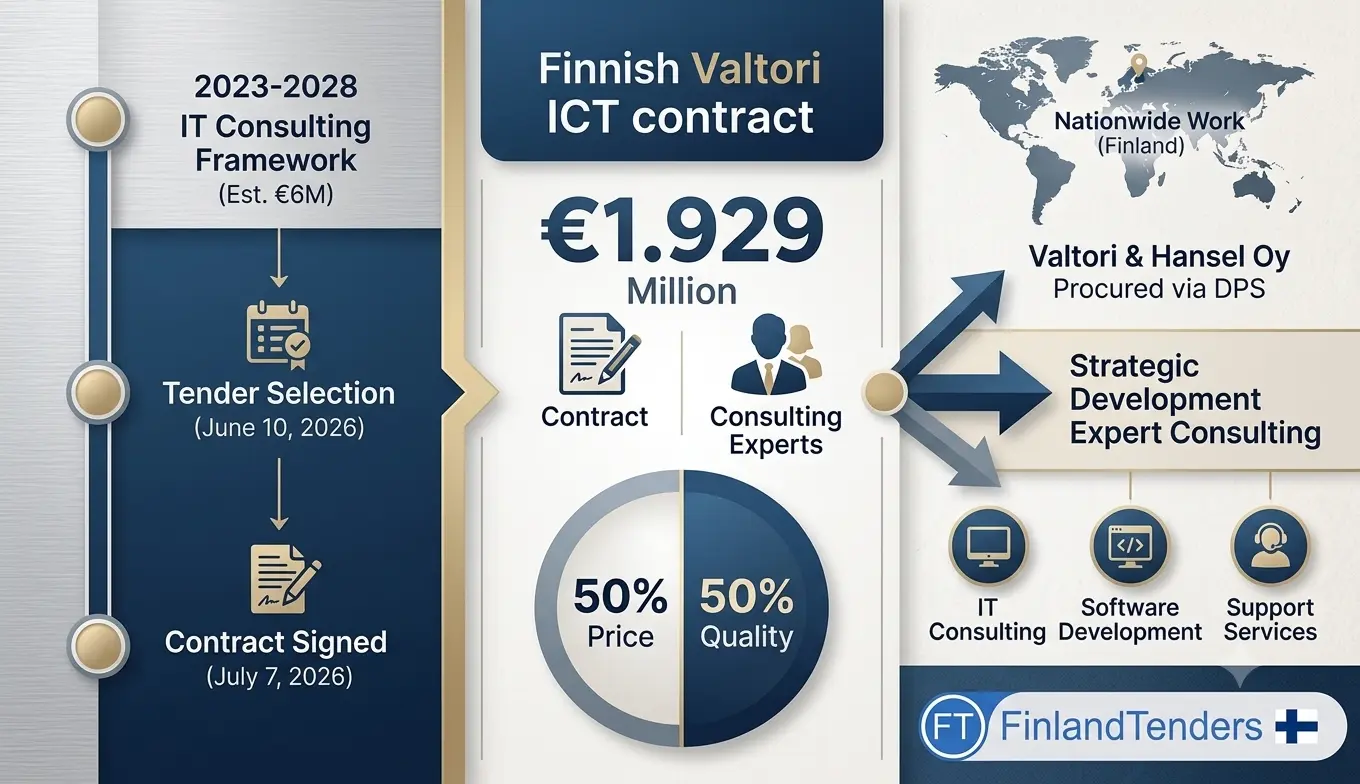
Finnish Government Secures €6 Million Strategic IT Consulting Framework Through 2028
13 Jul 2026
Finland's Valtori Awards €6 Million Strategic IT Consulting Framework to Capgemini Finland Valtori, the Finnish government's ICT centre, has awarded a strategic development consulting framework worth up to €6 million to Capgemini Finland Oy. The 1.5-year contract, with options for two additional years, will provide expert advisory services for Finland's public sector digital transformation. The deal illustrates how Nordic governments are leveraging dynamic procurement systems to access high-level strategic IT expertise. Introduction Every digital service a citizen uses, from healthcare portals to tax filing systems, depends on strategic IT decisions made years in advance. Someone has to plan that architecture. In Finland, that responsibility now partially sits with Capgemini Finland Oy, after Valtori, the state's centralized ICT centre, signed off on a new strategic development consulting contract worth up to €6 million over its initial term. It is not a headline-grabbing infrastructure deal. But it is the kind of contract that determines whether public sector IT systems remain fit for purpose, and it says a great deal about how Nordic governments are buying high-end consulting expertise at scale. Why This Contract Matters Finland's government runs one of the world's most digitized public sectors. But maintaining that position requires constant strategic foresight, understanding emerging technologies, planning system architectures, and ensuring interoperability across agencies. Individual ministries and agencies are too small to maintain this expertise in-house full-time. This contract is a textbook example of how centralized procurement bodies like Valtori aggregate demand for strategic expertise across the entire Finnish government. By establishing a framework for consulting services, they give agencies access to top-tier advisory capacity they could never justify hiring permanently. For consulting firms, it means one competitive process can open the door to a large, fragmented client base across Finland's public sector. For government agencies, it means access to expertise on demand, without the overhead of permanent recruitment. Contract Timeline Previous notice referenced: 42feb037-d2b7-4893-a1ee-005c6db7528d-01 Winner chosen: 10 June 2026 Contract concluded: 7 July 2026 Contract start date: 7 July 2026 Contract end date: 15 January 2028 (initial term) Renewal options: Two additional 1-year extensions available Contract Overview Valtori, operating through Hansel Oy as the central purchasing body, ran a restricted procedure for this strategic development consulting contract. The procurement was part of the broader "Valtori - IT Consulting 2023-2028" dynamic purchasing system (DPS), which aggregates IT consulting needs across the Finnish government. The contract was awarded following a competitive process where six tenders were received. The evaluation weighted price and quality equally at 50% each, with quality assessed based on consultants' experience and expertise exceeding the minimum requirements. The result is a direct contract for strategic development expert services, with assignments to be agreed during the contract period. The initial contract term is 1.5 years, with options for two additional one-year extensions, potentially extending coverage through early 2030. Key Contract Details Detail Information Contracting authorities Valtori (Valtion tieto- ja viestintätekniikkakeskus) & Hansel Oy Winning bidder Capgemini Finland Oy Contract subject Strategic development consulting services (IT consulting, CPV 72000000) Procedure type Restricted procedure Legal basis Directive 2014/24/EU Estimated value (ex-VAT) €6,000,000 Value of contract awarded €1,929,000 Contract duration 7 July 2026 – 15 January 2028 (1.5 years) Renewal options Two additional 1-year extensions Bids received 6 EU funding No Covered by GPA Yes Contract signed 7 July 2026 Project Scope The contract covers strategic development expert services for the Finnish government's ICT functions. The scope includes: Strategic IT development advisory Expert consulting on technology architecture and planning Support for digital transformation initiatives Specialized expertise in software and information systems (CPV 48000000) The contract operates on a call-off basis, with specific assignments agreed during the contract period. The estimated total value across the contract term is €6 million (excluding VAT), with the initial award to Capgemini valued at €1,929,000. A notable feature is the strategic procurement objective: the contract promotes human rights due diligence in global supply chains, reflecting growing public sector attention to ethical sourcing in IT services. About the Contracting Authorities Valtori (Valtion tieto- ja viestintätekniikkakeskus) is the Finnish government's ICT centre, responsible for providing centralized ICT services to central government agencies. Based in Jyväskylä, it manages a wide range of IT infrastructure, applications, and consulting services for the Finnish public sector. Hansel Oy acted as the central purchasing body for this procurement. Hansel is a public undertaking owned by the Finnish state that manages centralized procurement for government agencies, achieving economies of scale and professionalizing public buying. Its role in this contract was to run the procurement process on behalf of Valtori. About the Winning Company Capgemini Finland Oy is a Finnish subsidiary of the global Capgemini Group, a multinational IT consulting and services company. The company is classified as a micro, small, or medium enterprise (SME) in this procurement context, registered in Helsinki. Capgemini Finland provides a range of IT consulting, systems integration, and managed services to both public and private sector clients. This contract win strengthens its position in the Finnish public sector IT consulting market, building on its existing government relationships. Procurement Analysis Procedure: A restricted procedure was used, allowing the buyer to pre-qualify bidders before inviting tenders. This is standard practice for strategic consulting services where quality and expertise are critical differentiators. The procedure was not accelerated, indicating a standard timeline was followed. Competition: Six tenders were received. This represents healthy competition for a specialized strategic consulting contract in Finland's relatively small public sector IT market. Evaluation criteria: Quality and price were weighted equally at 50% each. The quality criterion assessed consultants' experience and expertise exceeding minimum requirements. This balanced approach recognizes that while cost matters, the caliber of strategic advice is equally important for long-term IT planning. Framework structure: This is a direct contract, not a framework agreement. However, it sits within the broader "Valtori - IT Consulting 2023-2028" dynamic purchasing system, which provides a mechanism for ongoing IT consulting procurement across the government. GPA status: The contract falls under the WTO's Government Procurement Agreement, meaning it was open to qualifying international bidders, though the winning bidder is a Finnish-registered company. Additional Procurement Facts The contract references a previous notice (42feb037-d2b7-4893-a1ee-005c6db7528d-01), which established the broader IT consulting DPS. No dynamic purchasing system was used for this specific award (it was a direct call-off from the DPS). The contract promotes human rights due diligence in global supply chains as a strategic procurement objective. Review deadlines for procurement challenges are 14 days under Finnish law, with the Market Court (Markkinaoikeus) as the review body. The procurement is not financed with EU funds. Market & Industry Perspective Finland's public sector IT market is one of Europe's most mature, with centralized procurement bodies like Hansel and Valtori driving consolidation and professionalization. This contract reflects a broader trend: governments moving away from piecemeal IT consulting procurement toward centralized frameworks that provide consistency, quality, and value. The equal weighting of quality and price is notable in an era of cost-conscious public spending. It signals that Finnish government buyers recognize the importance of strategic expertise, poor IT architecture decisions can cost far more than the consulting fees paid to get them right. For consulting firms, the Finnish public sector offers a stable, recurring revenue stream. The DPS structure means firms that qualify can access opportunities across multiple agencies without re-qualifying each time, reducing procurement overhead for both buyers and suppliers. Economic Significance At up to €6 million over the full potential term (1.5 years plus two one-year options), this contract is modest by global consulting standards. But its significance lies in its role: strategic IT consulting shapes the architecture of government services that millions of Finnish citizens depend on. The 1.5-year initial term, with two one-year extensions, gives both Valtori and its agency clients budget predictability. The option structure also allows flexibility: if the engagement proves valuable, it can be extended; if priorities shift, the contract can expire without penalty. Future Procurement Opportunities The contract includes two one-year extension options, meaning the engagement could run through early 2030 if exercised. Beyond this specific contract, the broader "Valtori - IT Consulting 2023-2028" DPS continues to generate opportunities for IT consulting across Finnish government agencies. Firms interested in the Finnish public sector should monitor the DPS for additional call-offs and related opportunities. The DPS structure means new requirements can be published at any time, creating a pipeline of potential work for qualified suppliers. Opportunities for Suppliers IT consulting firms active in the Nordic public sector should note that contracts of this kind recur predictably through DPS structures. Firms with strong expertise in strategic IT development, digital transformation, and public sector architecture are well-positioned. The equal weighting of quality and price means firms should invest in demonstrating deep expertise and track record, not just competitive pricing. The strategic procurement objective around human rights due diligence also suggests that firms with strong ESG credentials may have a competitive advantage in future tenders. What Businesses Should Watch Exercise of extension options: Whether Valtori exercises the two one-year extensions will signal satisfaction with Capgemini's performance and potential for future work. Additional DPS call-offs: The broader IT consulting DPS will continue to generate opportunities; firms should ensure they are qualified. Quality focus: The equal weighting of quality and price suggests a maturing procurement approach that values expertise over the lowest price. Strategic procurement trends: The inclusion of human rights due diligence requirements may become more common in Finnish public IT procurement. FinlandTenders.com Procurement Intelligence This contract is a useful case study in how Finland manages a structural challenge: maintaining world-class public sector IT requires access to strategic expertise that individual agencies can't justify in-house. The Valtori/Hansel model solves this by centralizing procurement, and this award shows the model working effectively. The equal weighting of quality and price is a notable signal. It suggests that Finnish government buyers, like their counterparts in other mature procurement markets, are moving away from lowest-price-dominated awards toward value-based procurement. Strategic consulting is recognized as a service where expertise matters more than cost per hour. For suppliers, the lesson is that competing on expertise and track record, not just price, is what wins these tenders. Firms that can demonstrate deep public sector experience, strategic thinking, and delivery capability, alongside competitive pricing, are best placed as Finland continues its digital transformation journey. Supplier Takeaways Finnish public sector IT consulting opportunities are accessible through the Valtori DPS structure, worth mapping for pipeline visibility. Quality and price are weighted equally; suppliers should lead proposals with evidence of expertise and track record. Strategic procurement objectives around human rights due diligence are becoming more common; suppliers should develop relevant credentials. Contract extensions can provide multi-year revenue certainty; performance during the initial term is critical. The DPS model means ongoing opportunities exist for qualified suppliers across multiple agencies. Key Takeaways Valtori awarded a strategic development consulting contract worth up to €6 million to Capgemini Finland Oy. The initial 1.5-year contract runs from July 2026 to January 2028, with two one-year extension options. Six bids were received through a restricted procedure with equal weighting of quality and price. The contract promotes human rights due diligence in global supply chains. The engagement provides strategic IT expertise across Finland's central government agencies. Conclusion This is not a contract that will make national headlines, but it reflects something structurally important about how Finland maintains its world-class public sector IT. By centralizing procurement through Valtori and Hansel, the government ensures agencies have access to strategic expertise that would otherwise be commercially unreachable. Capgemini Finland now carries that responsibility through the initial contract term, with potential extensions into the next decade. Frequently Asked Questions Q: What is Valtori? A: Valtori (Valtion tieto- ja viestintätekniikkakeskus) is the Finnish government's ICT centre, providing centralized IT services to central government agencies. Q: What does strategic development consulting cover? A: It covers expert advisory services for IT strategy, architecture planning, digital transformation, and software/information systems development. Q: Why are quality and price weighted equally? A: The buyer recognizes that strategic consulting expertise is as important as cost for making long-term IT decisions that affect millions of citizens. Q: What is the dynamic purchasing system (DPS)? A: It's a procurement mechanism that allows government agencies to access IT consulting services from pre-qualified suppliers on an ongoing basis, reducing the need for repeated tenders. Q: Is this contract funded by the EU? A: No. The procurement is fully financed by the Finnish government, not EU funds. Source EU Official Journal, Notice publication number: 480604-2026, OJ S 132/2026, published 13 July 2026. Available at: https://ted.europa.eu/en/notice/-/detail/480604-2026
View Details