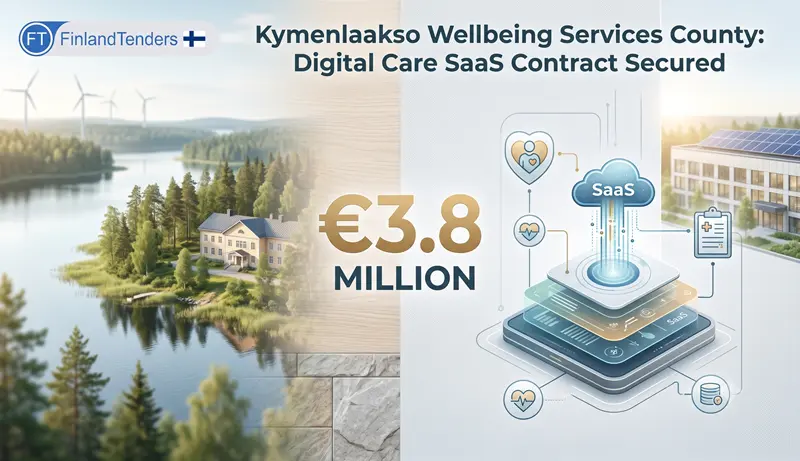
Kymenlaakso Wellbeing Services County Secures €3.8 Million SaaS Contract for Digital Care Management System
20 Jul 2026
A contract for a digital care management process system as a SaaS service worth €3.8 million has been awarded by the Kymenlaakso Wellbeing Services County. The contract, won by Buddy Healthcare Ltd Oy, demonstrates how Finnish healthcare regions are leveraging digital solutions to improve patient care pathways and ensure patient safety. Introduction Every patient in Finland's healthcare system deserves timely, appropriate, and safe care. Managing the flow of patients across different healthcare services is a complex challenge that requires sophisticated digital solutions. The Kymenlaakso Wellbeing Services County has taken a significant step to address this by awarding a new contract for a digital care management process system as a Software-as-a-Service (SaaS) solution. While not a headline-grabbing infrastructure deal, this contract is fundamental to ensuring that patients in Kymenlaakso receive the right care at the right time. It reveals a great deal about how Finnish healthcare regions are modernising patient pathways through digital innovation. Why This Contract Matters Kymenlaakso Wellbeing Services County is responsible for organising healthcare, social welfare, and rescue services for approximately 160,000 residents in southeastern Finland. Managing patient flows across primary care, specialised care, and social services is a complex challenge that requires effective digital tools. The digital care management system will guide symptom-based patient triage across large patient groups, ensuring that patients are directed to the appropriate level of care while maintaining patient safety. The SaaS model ensures that the system is continuously updated with the latest technology and clinical best practices. Contract Timeline Previous notice referenced: 3f5ce580-0658-4302-8b85-cd8e1d955ef6-01 Contract award notice published: 20 July 2026 (OJ S 137/2026) Date winner chosen: 20 February 2026 Contract concluded: 27 May 2026 Contract Overview Kymenlaakson hyvinvointialue conducted an open procedure for a digital care management process system delivered as a SaaS service. The system supports the contracting authority's care management processes by guiding symptom-based patient triage across large patient groups within healthcare services. The contract value awarded is €3,799,997. The contract includes all product development necessary for modern digital care management processes, ensuring that the system continuously evolves with the latest technology. The duration of the contract is not fixed, with services provided on an ongoing basis. Key Contract Details Detail Information Contracting Authority Kymenlaakson hyvinvointialue (Kymenlaakso Wellbeing Services County) Winning Bidder Buddy Healthcare Ltd Oy Contract Subject Software package and information systems (CPV 48000000) Procedure Type Open procedure Legal Basis Directive 2014/24/EU Value of Contract Awarded €3,799,997.00 Contract Duration Unlimited (ongoing SaaS service) Award Criteria Total Price (100%) Bids Received 2 EU Funding None disclosed Covered by GPA Yes Review Organisation Markkinaoikeus (Market Court) Project Scope The contract covers a digital care management process system delivered as a SaaS service. The system supports the contracting authority's care management processes by: Symptom-Based Triage: Guiding patients based on their symptoms to the appropriate level of care across healthcare services. Patient Safety: Ensuring patient safety throughout the care management process. Continuous Development: Including all product development necessary for modern digital care management processes. Technology Modernisation: Utilising the most modern technology to continuously improve care pathways. The system covers large patient groups, ensuring that the contracting authority's objectives for digital care management are achieved. The SaaS delivery model ensures that the system is continuously updated with the latest features and technology. About the Contracting Authority Kymenlaakson hyvinvointialue (Kymenlaakso Wellbeing Services County) is a regional authority responsible for organising healthcare, social welfare, and rescue services in the Kymenlaakso region of southeastern Finland. Based in Kotka, the county serves approximately 160,000 residents across municipalities including Kotka, Kouvola, and surrounding areas. The county is committed to modernising healthcare delivery through digital innovation, improving patient pathways, and ensuring equitable access to care. About the Winning Company Buddy Healthcare Ltd Oy is a small Finnish health technology company based in Helsinki. The company specialises in digital care management solutions, patient engagement platforms, and healthcare process automation. Buddy Healthcare's solutions are designed to improve patient pathways, enhance care coordination, and support clinical decision-making. As a Finnish SME, the company is well-positioned to understand the specific requirements of the Finnish healthcare system. Procurement Analysis Procedure: An open procedure was used, subject to Finnish procurement regulations. Two tenders were received. Competition: Two bids were received for this contract, indicating a competitive market for digital healthcare solutions in Finland. Award Criteria: Total price was the sole award criterion, with 100% weighting. This price-based approach reflects the nature of SaaS solutions, where the service offering and functionality are clearly specified, making price the primary differentiator. SaaS Model: The Software-as-a-Service delivery model ensures that the system is continuously updated with the latest technology, including product development as part of the service. This model reduces the need for large upfront capital investments and ensures that the system evolves with changing clinical requirements. GPA Status: The procurement is covered by the World Trade Organization's Government Procurement Agreement (GPA), meaning it was, in principle, open to qualifying international bidders. Additional Procurement Facts Only two tenders were received for this procurement. No subcontracting was used by the winning bidder. The contract includes all product development necessary for modern digital care management processes. The SaaS model ensures continuous technology modernisation. No EU funding was used for this procurement. The contract duration is not fixed, with services provided on an ongoing basis. Disputes or review requests fall to the Markkinaoikeus (Market Court) in Helsinki. Market & Industry Perspective The digital healthcare market in Finland is growing rapidly, driven by the need to improve patient access, reduce healthcare costs, and leverage technology for better clinical outcomes. The SaaS model is increasingly popular for healthcare IT solutions, offering flexibility, continuous updates, and reduced capital expenditure. The price-based award criteria (100% price) reflects the well-defined nature of the SaaS solution requirements. With the functionality clearly specified, the contracting authority can compare bids primarily on cost while ensuring that the technical requirements are met by all qualifying bidders. The inclusion of all product development in the service offering ensures that the system will continuously evolve with modern digital care management practices, providing long-term value to the contracting authority. Economic Significance At €3.8 million, this contract represents a significant investment in digital healthcare infrastructure for the Kymenlaakso region. The system will improve patient pathways, reduce unnecessary healthcare visits, and ensure that patients receive care at the appropriate level. For Buddy Healthcare Ltd Oy, the contract provides a stable revenue stream and the opportunity to demonstrate its solutions in a major Finnish healthcare region. Future Procurement Opportunities Other Finnish wellbeing services counties may adopt similar digital care management solutions, creating opportunities for suppliers with proven SaaS platforms. The Kymenlaakso contract may serve as a reference for other regions planning comparable procurements. Related procurement opportunities may include integration with electronic health records (EHR) systems, patient portals, and other healthcare IT infrastructure. Opportunities for Suppliers Health technology companies active in the Finnish public sector should note the growing demand for SaaS-based care management solutions. The price-based award criteria (100% price) rewards suppliers who can offer competitive pricing while meeting all technical requirements. Key success factors include: competitive pricing, a robust SaaS platform with proven functionality, compliance with Finnish healthcare regulations, and the ability to deliver continuous product development and updates. What Businesses Should Watch Whether other Finnish wellbeing services counties adopt similar SaaS-based care management solutions. The evolution of care management requirements and clinical best practices in Finnish healthcare. Opportunities for system integration with other healthcare IT systems. Potential renewals or expansions of this contract. FinlandTender Procurement Intelligence This contract is a useful case study in how Finnish wellbeing services counties are modernising patient pathways through digital innovation. Kymenlaakson hyvinvointialue has secured a €3.8 million SaaS solution for digital care management, with Buddy Healthcare Ltd Oy selected as the winner through a price-based open procedure. The most interesting feature of this tender is the 100% weighting for price. For SaaS solutions where functionality is clearly specified and quality assurance is managed through service level agreements and regulatory compliance, price is the most appropriate differentiator. This approach rewards suppliers who can deliver cost-effective solutions while meeting all technical requirements. The SaaS delivery model, with all product development included, represents a modern approach to healthcare IT procurement. Rather than purchasing a static software solution, the contracting authority is procuring a continuously evolving service that will adapt to changing clinical requirements and technological advancements. For suppliers, the lesson is that price competitiveness is essential for SaaS solutions in the Finnish public sector. However, companies must also demonstrate a robust platform, compliance with healthcare regulations, and the ability to deliver continuous development and support. Supplier Takeaways Price is the dominant factor in SaaS healthcare solutions where functionality is clearly specified. SaaS delivery with continuous product development is increasingly preferred by public sector buyers. Compliance with healthcare regulations and patient safety requirements is essential. The Finnish wellbeing services county market offers opportunities for digital health solutions. Integration capabilities with existing healthcare IT systems are critical success factors. Key Takeaways Kymenlaakson hyvinvointialue awarded a €3.8 million SaaS contract for digital care management to Buddy Healthcare Ltd Oy. The system guides symptom-based patient triage across large patient groups. Award criteria: Total Price (100%). Two bids were received, with a small Finnish SME winning the contract. The SaaS model includes all product development, ensuring continuous technology modernisation. The contract supports patient safety and efficient care pathways in Kymenlaakso. Conclusion This is not a contract that will make national headlines, but it reflects something structurally important about how Finnish healthcare is being modernised through digital innovation. By awarding a €3.8 million SaaS contract for digital care management to Buddy Healthcare Ltd Oy, Kymenlaakson hyvinvointialue ensures that patients in the region receive appropriate, timely, and safe care. The contract demonstrates the value of SaaS solutions in healthcare, the importance of price competitiveness, and the growing role of digital innovation in patient pathway management. Frequently Asked Questions Q: What is Kymenlaakson hyvinvointialue? It is a wellbeing services county responsible for organising healthcare, social welfare, and rescue services in the Kymenlaakso region of southeastern Finland. Q: What is the digital care management system? It is a SaaS-based system that guides symptom-based patient triage, ensuring patients are directed to the appropriate level of care while maintaining patient safety. Q: What is a SaaS service? Software-as-a-Service (SaaS) is a delivery model where software is provided as a service over the internet, with continuous updates and maintenance included in the service. Q: Why was price the only award criterion? The functionality was clearly specified in the tender documents, and with all bids required to meet the same technical requirements, price became the primary differentiator. Q: Is this contract funded by the EU? No. The notice confirms the project is not financed with EU funds, though it is governed by EU Directive 2014/24/EU.Source: EU Official Journal, Contract Award Notice 498134-2026, OJ S 137/2026, published 20 July 2026.
View Details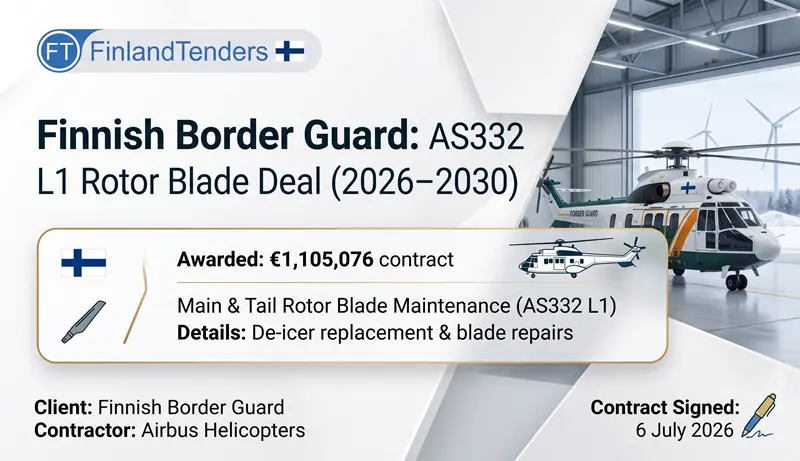
Finnish Border Guard Secures €1.1 Million Contract for AS332 L1 Helicopter Rotor Blade Maintenance
17 Jul 2026
A contract for the maintenance of tail and main rotor blades for AS332 L1 helicopters worth €1.1 million has been awarded by the Finnish Border Guard. The contract, won by Airbus Helicopters, demonstrates the specialized nature of military helicopter maintenance and the critical importance of ensuring operational readiness for Finland's border security operations. Introduction Every helicopter operated by the Finnish Border Guard depends on meticulously maintained rotor blades to ensure flight safety and operational readiness. The AS332 L1 Super Puma helicopters, used for border surveillance, search and rescue, and other critical missions, require specialized maintenance services that only a limited number of suppliers can provide. The Finnish Border Guard has taken a significant step to ensure this capability by awarding a new contract for tail and main rotor blade maintenance services. While not a headline-grabbing deal, this contract is fundamental to ensuring the operational capability of Finland's border security helicopter fleet. It reveals a great deal about how military aviation procurement is structured and the specialized requirements of helicopter maintenance. Why This Contract Matters The Finnish Border Guard operates a fleet of helicopters for a wide range of missions, including border surveillance, maritime patrol, search and rescue, and law enforcement support. The AS332 L1 Super Puma is a key platform for these operations, particularly in the challenging conditions of the Baltic Sea and Finland's extensive archipelagos. Rotor blades are among the most critical components of any helicopter. They must be maintained to exacting standards, with repairs and replacements performed only by authorized and qualified technicians. The specialized nature of this work means that the market is limited, and the Finnish Border Guard must procure these services from the original equipment manufacturer (OEM) or specialized maintenance providers. Contract Timeline Previous notice referenced: 2e0c8d93-d30f-4488-9ba3-5239b64c9024-01 Contract award notice published: 17 July 2026 (OJ S 136/2026) Date winner chosen: 2 June 2026 Contract concluded: 6 July 2026 Coverage start date: 31 May 2026 Coverage end date: 31 December 2030 Contract Overview The Finnish Border Guard conducted an open procedure for the maintenance of AS332 L1 tail and main rotor blades. The contract includes de-icer replacement for tail rotor blades at 2,000 flight hours, as well as repairs for main rotor blades including leading edge replacement. The estimated quantity of services is 16 tail rotor blade de-icer replacements and 2-4 main rotor blade repairs during the contract period. The contract also includes an option for unforeseen and unscheduled repair services during the contract period. The total contract value awarded is €1,105,076. The contract duration is approximately 4.5 years, from May 2026 to December 2030. Key Contract Details Detail Information Contracting Authority Finnish Border Guard Winning Bidder Airbus Helicopters Contract Subject AS332 L1 tail and main rotor blade maintenance services (CPV 50212000) Procedure Type Open procedure Legal Basis Directive 2014/24/EU, Finland Act 1397/2016 Value of Contract Awarded €1,105,076.00 Contract Duration 31 May 2026 – 31 December 2030 (approx. 4.5 years) Award Criteria Price (80%), Turnaround Time (20%) Bids Received 1 EU Funding None disclosed Covered by GPA Yes Review Organisation Markkinaoikeus (Market Court) Project Scope The contract covers the following maintenance services for the Finnish Border Guard's AS332 L1 Super Puma helicopters: Tail Rotor Blade De-Icer Replacement: Replacement of de-icer systems on tail rotor blades P/N 332A12-0055-01 and P/N 332A12-0055-04 at 2,000 flight hours. Maintenance task reference: 64/10/00/401/000/086. Estimated quantity: 16 units. Main Rotor Blade Repairs: Repairs to main rotor blades P/N 332A11-0032-03 and P/N 332A11-0032-09, including leading edge replacement. Estimated quantity: 2-4 units. Unforeseen and Unscheduled Repairs: The contract includes an option for unforeseen and unscheduled repair services as required. The quantity and schedule of replacements may vary based on accumulated flight hours or other unscheduled events. The place of performance is not fixed, with services to be delivered at the contractor's facilities or other agreed locations. About the Contracting Authority Finnish Border Guard is a central government authority responsible for border security, maritime surveillance, search and rescue, and law enforcement operations in Finland's border areas and territorial waters. The Border Guard operates a fleet of helicopters, including the AS332 L1 Super Puma, for a wide range of missions. The Commercial Unit of the Finnish Border Guard, based in Helsinki, manages procurement for the organization. About the Winning Company Airbus Helicopters is a large French aerospace company and a division of Airbus, headquartered in Marignane, France. As the original equipment manufacturer (OEM) of the AS332 L1 Super Puma helicopter, Airbus Helicopters is uniquely qualified to provide maintenance services for rotor blades and other critical components. The company has extensive expertise in helicopter design, production, and maintenance, with a global network of service centers. As the manufacturer, Airbus Helicopters has access to the original technical specifications, tooling, and certified technicians required for this specialized work. Procurement Analysis Procedure: An open procedure was used, subject to Finland's Act on Public Procurement and Concession Contracts (1397/2016). The evaluation process followed a three-step approach: evaluation of suitability of tenderers, verification that tenders meet requirements, and comparison of qualifying tenders. Competition: Only one bid was received (from Airbus Helicopters), reflecting the specialized nature of the maintenance services required. The limited competition is typical for OEM-specific military aviation maintenance, where the manufacturer possesses unique technical knowledge and certification. Award Criteria: Price was weighted at 80%, while turnaround time was weighted at 20%. This weighting prioritizes cost efficiency while recognizing the importance of rapid service delivery to minimize aircraft downtime. Strategic Procurement: The contract includes strategic procurement objectives, with the contracting authority promoting the transition to a circular economy and fair working conditions. This reflects the Finnish public sector's commitment to sustainability and social responsibility. GPA Status: The procurement is covered by the World Trade Organization's Government Procurement Agreement (GPA), meaning it was, in principle, open to qualifying international bidders. Additional Procurement Facts Only one tender was received, from Airbus Helicopters. No subcontracting was used by the winning bidder. The contract includes an option for unforeseen and unscheduled repair services. The quantity of services may vary based on accumulated flight hours or unscheduled events. The place of performance is not fixed; services can be delivered at the contractor's facilities or other agreed locations. No EU funding was used for this procurement. Disputes or review requests fall to the Markkinaoikeus (Market Court) in Helsinki. The contract is governed by Finland's Act on Public Procurement and Concession Contracts (1397/2016). Market & Industry Perspective The military helicopter maintenance market is highly specialized, with OEMs like Airbus Helicopters often being the only fully qualified providers for critical components such as rotor blades. This is due to the stringent safety requirements, proprietary technical specifications, and certification requirements for aviation components. The weighting of the award criteria (80% price, 20% turnaround time) reflects the balance between cost efficiency and operational readiness. For military operators, minimizing aircraft downtime is critical, and rapid turnaround on maintenance services can be as important as price. The inclusion of circular economy and fair working conditions as strategic procurement objectives aligns with broader European and Finnish public procurement trends, where sustainability and social responsibility are increasingly important evaluation factors. Economic Significance At €1.1 million over approximately 4.5 years, this contract represents a moderate but significant investment in the operational readiness of the Finnish Border Guard's helicopter fleet. The contract ensures that critical rotor blade maintenance can be performed by the OEM, maintaining the highest safety and quality standards. The option for unforeseen and unscheduled repairs provides flexibility to address unexpected maintenance needs, ensuring that the Border Guard can maintain operational capability even in unplanned circumstances. Future Procurement Opportunities This contract covers rotor blade maintenance through 2030. Other maintenance services for the AS332 L1 fleet, including engine maintenance, avionics upgrades, and airframe inspections, may be procured separately. Suppliers with specialized capabilities in military helicopter maintenance should monitor future tenders from the Finnish Border Guard and other Nordic military operators. The Finnish Border Guard's helicopter fleet is expected to continue operating through the 2030s, with potential fleet renewal or upgrade programs creating additional procurement opportunities. Opportunities for Suppliers Companies specializing in military aviation maintenance should note the specialized nature of this market and the importance of OEM certification. For non-OEM suppliers, opportunities may arise through subcontracting arrangements with primary contractors like Airbus Helicopters, or through providing complementary services. Key success factors include: OEM certification and technical qualification, documented experience with military aviation maintenance, competitive pricing, and demonstrated ability to deliver rapid turnaround times. What Businesses Should Watch Future tenders for other maintenance services on the Finnish Border Guard's AS332 L1 fleet. Potential fleet renewal or upgrade programs for Finnish military helicopters. Similar procurement opportunities from other Nordic military operators. Opportunities for subcontracting with Airbus Helicopters on this and future contracts. FinlandTender Procurement Intelligence This contract is a useful case study in how military aviation maintenance is procured by European border security agencies. The Finnish Border Guard has secured specialized rotor blade maintenance services from the OEM, Airbus Helicopters, ensuring the highest quality and safety standards for its AS332 L1 fleet. The most interesting signal is the 80/20 weighting between price and turnaround time. While cost efficiency is clearly important, the recognition of turnaround time as a quality factor reflects the operational reality of military aviation: aircraft downtime directly impacts mission capability, and rapid maintenance delivery is critical. The limited competition (only one bidder) is typical for this type of procurement, where the OEM possesses unique technical knowledge, tooling, and certification. This highlights the importance of maintaining strong relationships with OEMs for military operators, as well as the challenges of introducing competition in specialized technical markets. The inclusion of circular economy and fair working conditions as strategic objectives is noteworthy. Even in highly specialized technical procurements, the Finnish public sector is embedding sustainability and social responsibility considerations, reflecting a broader European trend toward values-based procurement. For suppliers, the lesson is that OEM certification and technical qualification are essential for military aviation maintenance contracts. Companies seeking to enter this market must invest in certification and demonstrate the technical capability to maintain aircraft to the highest safety standards. Supplier Takeaways OEM certification is essential for military aviation maintenance contracts; non-OEM suppliers should seek subcontracting opportunities. Price is important (80% weighting), but turnaround time (20%) is also critical for operational readiness. Strategic procurement objectives (circular economy, fair working conditions) are increasingly important evaluation factors. Military operators value long-term relationships with qualified maintenance providers. Single-bidder tenders are common in specialized technical markets; competition is limited by certification requirements. Key Takeaways Finnish Border Guard awarded a €1.1 million contract for AS332 L1 rotor blade maintenance to Airbus Helicopters. The contract covers tail rotor blade de-icer replacement and main rotor blade repairs. Award criteria: Price (80%), Turnaround Time (20%). Only one bid was received, from the OEM, Airbus Helicopters. Contract duration: approximately 4.5 years (May 2026 to December 2030). The contract includes strategic procurement objectives: circular economy and fair working conditions. Conclusion This is not a contract that will make national headlines, but it reflects something structurally important about how military aviation maintenance is procured. By awarding a €1.1 million contract for AS332 L1 rotor blade maintenance to Airbus Helicopters, the Finnish Border Guard ensures that its helicopter fleet maintains the highest safety and operational standards. The contract demonstrates the importance of OEM certification, the balance between price and turnaround time, and the growing influence of strategic procurement objectives in specialized technical markets. Frequently Asked Questions Q: What is the Finnish Border Guard? It is a central government authority responsible for border security, maritime surveillance, search and rescue, and law enforcement operations in Finland's border areas and territorial waters. Q: What aircraft does this contract cover? It covers maintenance services for the AS332 L1 Super Puma helicopter, a medium-lift helicopter used by the Finnish Border Guard for various missions. Q: What is a rotor blade de-icer? It is a system that prevents ice from forming on helicopter rotor blades, which is critical for safe operation in cold and icy conditions. Q: Why was Airbus Helicopters the only bidder? As the original equipment manufacturer (OEM) of the AS332 L1, Airbus Helicopters possesses unique technical knowledge, tooling, and certification required for this specialized maintenance work. Q: Is this contract funded by the EU? No. The notice confirms the project is not financed with EU funds, though it is governed by EU Directive 2014/24/EU.Source: EU Official Journal, Contract Award Notice 494326-2026, OJ S 136/2026, published 17 July 2026.
View Details
Finland's Regional Health Authorities Secure €1.35 Million Framework for Hearing Impairment Aids
16 Jul 2026
A joint procurement by three Finnish wellbeing services counties has resulted in a series of contracts worth up to €1.35 million for assistive devices for people with hearing impairments. The tender, won primarily by Kuulotekniikka Hakala Oy across multiple lots, demonstrates how Finnish healthcare regions are collaborating to achieve better value in specialized medical equipment procurement. Introduction Every day, thousands of people across Finland's wellbeing services counties rely on assistive devices to navigate a world designed for hearing individuals. From vibrating alarm clocks to induction loop systems and specialized headphones, these tools are essential for independent living. In the Varsinais-Suomi, Satakunta, and Pohjanmaa regions, the responsibility for providing these devices now rests with a series of contracts awarded through a joint procurement framework. This is not a headline-grabbing infrastructure deal. But it is the kind of procurement that directly impacts the quality of life for citizens with hearing impairments, and it reveals a great deal about how Finnish public healthcare authorities are collaborating to procure specialized medical equipment at scale. Why This Contract Matters Finland's 21 wellbeing services counties (hyvinvointialueet) are responsible for organizing healthcare, social welfare, and rescue services. Many of these regions are, individually, too small to negotiate favorable terms for specialized assistive devices. By collaborating on joint procurement, three counties—Varsinais-Suomi, Satakunta, and Pohjanmaa—have pooled their demand for hearing impairment aids into a single, coordinated tender. For suppliers, this means one competitive process can open the door to a substantial client base across multiple regions. For the counties, it means access to group purchasing power and standardized pricing they could never secure alone. Contract Timeline Contract award notice published: 16 July 2026 (OJ S 135/2026) Contracts concluded: 4 February 2026 and 16 February 2026 Notice reference: 492438-2026 Contract Overview The procurement was conducted as an open procedure by three wellbeing services counties acting jointly. The contract covers a wide range of assistive devices for people with hearing impairments, organized into 18 separate lots. The tenders were evaluated solely on price, with 100 points awarded to the lowest-priced compliant bid. The total value of all contracts awarded is €1,350,000, though this figure represents only the initial commitment, with the actual value depending on demand throughout the contract period. Key Contract Details Detail Information Contracting Authorities Varsinais-Suomen hyvinvointialue (lead buyer)Satakunnan hyvinvointialuePohjanmaan hyvinvointialue Primary Winning Bidder Kuulotekniikka Hakala Oy (multiple lots) Secondary Winning Bidder Qlu Oy (lots 16 and 17) Contract Subject Hearing impairment assistive devices (CPV 33000000) Procedure Type Open procedure Legal Basis Directive 2014/24/EU Total Value of Contracts Awarded €1,350,000.00 Lots Awarded 7 out of 18 lots awarded EU Funding None disclosed Covered by GPA Yes Review Organisation Markkinaoikeus (Market Court) Lots and Award Results LOT-0001: Table and wall clocks, analog — Result: No winner selected. All tenders withdrawn or inadmissible. LOT-0002: Table and wall clocks, digital (mains powered) — Winner: Kuulotekniikka Hakala Oy — Value: €26,105.00 LOT-0003: Table and wall clocks, battery powered, digital — Result: No winner selected. All tenders withdrawn or inadmissible. LOT-0004: Table and wall clocks (additional lot) — Result: No winner selected. All tenders withdrawn or inadmissible. LOT-0005: Telephone accessories, phone ring indicators — Result: No winner selected. All tenders withdrawn or inadmissible. LOT-0006: Telephone accessories, wireless Bluetooth vibration indicators — Winner: Kuulotekniikka Hakala Oy — Value: €8,366.00 LOT-0007: Telephone accessories, external telephone amplifiers — Result: No winner selected. All tenders withdrawn or inadmissible. LOT-0008: Induction loop systems, personal, mobile phone induction loops, Bluetooth — Result: No winner selected. All tenders withdrawn or inadmissible. LOT-0009: Induction loop systems, room-specific, fixed induction loops — Result: No winner selected. All tenders withdrawn or inadmissible. LOT-0010: Induction loop systems, personal, neckloop induction loops, radio frequency — Result: No winner selected. All tenders withdrawn or inadmissible. LOT-0011: Radio frequency transmitter systems, distance listening systems — Result: No winner selected. All tenders withdrawn or inadmissible. LOT-0012: Radio frequency headphones, TV/radio listening headphones — Result: No winner selected. All tenders withdrawn or inadmissible. LOT-0013: Wired headphones, ear bud headphones — Winner: Kuulotekniikka Hakala Oy — Value: €26,292.00 LOT-0014: Wired headphones, headband headphones — Winner: Kuulotekniikka Hakala Oy — Value: €26,292.00 LOT-0015: Wired headphones, stetoclip headphones — Result: No winner selected. Only one admissible tender received. LOT-0016: Voice amplifiers, communicators with fixed microphone, min. 45 dB — Winners: Kuulotekniikka Hakala Oy (€31,458.00) and Qlu Oy (€56,078.00) LOT-0017: Voice amplifiers, communicators with fixed microphone, min. 50 dB — Winners: Kuulotekniikka Hakala Oy (€26,474.00) and Qlu Oy (€24,620.00) LOT-0018: General alarm systems — Winner: Kuulotekniikka Hakala Oy — Value: €1,159,964.00 About the Contracting Authorities Varsinais-Suomen hyvinvointialue is the wellbeing services county responsible for organizing healthcare, social welfare, and rescue services in the Varsinais-Suomi region of southwestern Finland. With Turku as its administrative center, it serves a population of approximately 480,000 residents. Satakunnan hyvinvointialue is the wellbeing services county for the Satakunta region on Finland's west coast, with Pori as its main city. It serves approximately 215,000 residents across 16 municipalities. Pohjanmaan hyvinvointialue is the wellbeing services county for the Ostrobothnia region, with Vaasa as its administrative center. The region is notable for its significant Swedish-speaking population and serves approximately 176,000 residents. These three counties collaborated on this joint procurement to leverage their combined purchasing power and ensure consistent availability of assistive devices across their regions. About the Winning Companies Kuulotekniikka Hakala Oy is a Finnish company specializing in assistive technology for people with hearing impairments. Based in Helsinki, the company is classified as a micro, small, or medium-sized enterprise (SME). It emerged as the dominant winner in this procurement, securing 6 of the 7 awarded lots, including the largest single lot (LOT-0018) valued at over €1.16 million. Qlu Oy is a Finnish company based in Oulu, also classified as an SME. The company won two lots (LOT-0016 and LOT-0017) for voice amplifiers, competing directly with Kuulotekniikka Hakala Oy in those categories. Procurement Analysis Procedure: An open procedure was used, which is the most transparent and inclusive method under EU law, allowing any interested supplier to submit a bid. Competition: Competition levels varied significantly by lot. The highest number of bids received for any lot was 3 (LOT-0002, LOT-0014, LOT-0016, LOT-0017, LOT-0018). Most lots received only 1 or 2 bids. Notably, 10 of the 18 lots (over 55%) received no successful awards, with all tenders either withdrawn or found inadmissible. Award Criteria: Price was the sole award criterion, with the lowest-priced compliant tender receiving 100 points. This is a pure price-based procurement approach, contrasting with the quality-weighted approach seen in the earlier German communications contract and French insurance contract. Lot Structure: The procurement was divided into 18 distinct lots, allowing suppliers to bid on specific product categories they could fulfill. This structure enables smaller, specialized suppliers to compete effectively without needing to cover the entire product range. Framework Agreement: No framework agreement was used. Individual contracts were awarded for each successful lot. GPA Status: The procurement is covered by the World Trade Organization's Government Procurement Agreement (GPA), meaning it was, in principle, open to qualifying international bidders. However, all winning bidders were Finnish companies. Additional Procurement Facts The procurement was a joint tender organized by Varsinais-Suomen hyvinvointialue acting as group leader. The notice includes a correction notice clarifying a technical requirement: for induction loop devices, the requirement was corrected from "optical audio output" to "optical audio input." No dynamic purchasing system was used. All winning contracts were signed on 4 February 2026, with one additional contract signed on 16 February 2026. Disputes or review requests fall to the Markkinaoikeus (Market Court) in Helsinki. All bids received were from SMEs; no large enterprises participated. Market & Industry Perspective The hearing impairment assistive devices market in Finland is relatively specialized, with a limited number of suppliers capable of providing the full range of products required. This was reflected in the procurement results, where only two companies—Kuulotekniikka Hakala Oy and Qlu Oy—emerged as successful bidders. The high number of lots with no successful awards (10 out of 18) suggests that either the requirements for those lots were too specific for available suppliers to meet, or the pricing expectations were not aligned with market realities. This pattern may indicate a need for future procurements to consider more flexible specifications or to adjust expectations on pricing. The dominance of a single supplier, Kuulotekniikka Hakala Oy, across multiple lots raises interesting questions about market concentration in this sector. However, the presence of Qlu Oy in two lots demonstrates that competition exists in at least some product categories. Economic Significance At €1.35 million, this is not a large contract by national infrastructure standards. However, it directly supports the independence and quality of life for citizens with hearing impairments across three Finnish regions. Without these devices, many individuals would face significant barriers to daily living, from receiving alarm notifications to communicating effectively. The procurement also demonstrates the economic impact of collaboration between wellbeing services counties. By joining forces, these three regions have created a unified procurement that reduces administrative overhead and ensures consistent access to essential medical devices. Future Procurement Opportunities The 11 lots that received no successful awards represent potential opportunities for future procurement. Suppliers capable of meeting the requirements for these product categories should monitor future tenders from these and other wellbeing services counties. Beyond this specific procurement, other wellbeing services counties across Finland conduct similar tenders for assistive devices on their own cycles. This tender, now a matter of public record, may serve as a reference for other regions planning comparable procurements. Opportunities for Suppliers Suppliers of hearing impairment assistive devices should note that joint procurements by wellbeing services counties are becoming increasingly common in Finland. The ability to meet the full range of product specifications and offer competitive pricing is essential for success. The pure price-based award criterion (100 points for price) means that suppliers competing in this market must focus on cost competitiveness above all else. However, the high rate of unsuccessful lots suggests that specifications may also need to be carefully reviewed to ensure they are achievable by available suppliers. What Businesses Should Watch Whether other wellbeing services counties adopt similar joint procurement approaches for assistive devices. The timing of future tenders for the 11 lots that received no successful awards. Whether the procurement model shifts to include quality criteria in future tenders. Uptake rates across the awarded contracts, which will determine the actual financial value beyond the initial commitments. FinlandTender Procurement Intelligence This contract is a useful case study in how Finland's wellbeing services counties are adapting to the new regional governance structure introduced in 2022. The three counties—Varsinais-Suomi, Satakunta, and Pohjanmaa—have demonstrated that collaboration can yield better procurement outcomes than individual efforts. The most striking feature of this tender is the pure price-based award criteria. Unlike the French insurance contract (where quality was weighted highest) or the German communications framework (70% quality), this Finnish medical supplies procurement prioritized price above all else. This is a traditional, cost-focused approach that treats medical equipment as a commodity rather than a service relationship. The results tell an interesting story. While Kuulotekniikka Hakala Oy secured the majority of awarded lots, 10 lots received no successful awards at all. This suggests that price-only evaluation may have discouraged some suppliers or that the specifications were too narrow to attract sufficient competition. It is a reminder that while price-based procurement can achieve cost savings, it may also lead to gaps in provision. For suppliers, the lesson is that cost leadership is essential in this segment. Companies that can offer the lowest prices while meeting specifications are best positioned to win these tenders. However, the high number of unsuccessful lots also indicates that there may be opportunities for suppliers who can meet specific technical requirements that others cannot. Supplier Takeaways Price competition is the dominant factor in this market segment; suppliers must be highly cost-competitive. The joint procurement model across regions offers access to a larger customer base through a single bidding process. Specialized suppliers should focus on lots where they have unique technical capabilities. The high number of unsuccessful lots suggests potential future opportunities for suppliers who can meet specific requirements. SME status is common among successful bidders; this market is accessible to smaller specialist companies. Key Takeaways Varsinais-Suomi, Satakunta, and Pohjanmaa wellbeing services counties conducted a joint procurement for hearing impairment assistive devices. Total value of contracts awarded: €1.35 million. Kuulotekniikka Hakala Oy was the dominant winner, securing 6 of 7 awarded lots. Qlu Oy won two lots for voice amplifiers. Price was the sole award criterion (100 points). 10 of 18 lots received no successful awards, suggesting potential gaps in supply. Conclusion This is not a contract that will make national headlines, but it reflects something structurally important about how Finland is organizing its public healthcare procurement. By pooling demand through regional collaboration, wellbeing services counties gain access to competitive pricing and standardized devices, and suppliers gain access to a consolidated customer base. Kuulotekniikka Hakala Oy and Qlu Oy now carry the responsibility of supplying hearing impairment aids to thousands of citizens across three Finnish regions. Frequently Asked Questions Q: What is a wellbeing services county (hyvinvointialue) in Finland? It is a regional authority responsible for organizing healthcare, social welfare, and rescue services. Finland has 21 such counties, established in 2022 as part of a major healthcare reform. Q: What does this procurement cover? It covers assistive devices for people with hearing impairments, including alarm clocks, telephone accessories, induction loop systems, headphones, voice amplifiers, and general alarm systems. Q: Why were so many lots unsuccessful? Ten of the 18 lots received no successful awards, with all tenders either withdrawn or found inadmissible. This may indicate that specifications were too narrow, pricing expectations were unrealistic, or insufficient suppliers were available. Q: What is an induction loop system? It is a system that transmits audio signals directly to hearing aids equipped with telecoils, allowing users to hear sound from public address systems, televisions, or telephones more clearly. Q: Is this contract open to international bidders? Yes, the procurement is covered by the WTO Government Procurement Agreement (GPA), making it theoretically open to qualifying international bidders. However, all winning bidders were Finnish companies.Source: EU Official Journal, Contract Award Notice 492438-2026, OJ S 135/2026, published 16 July 2026.
View Details